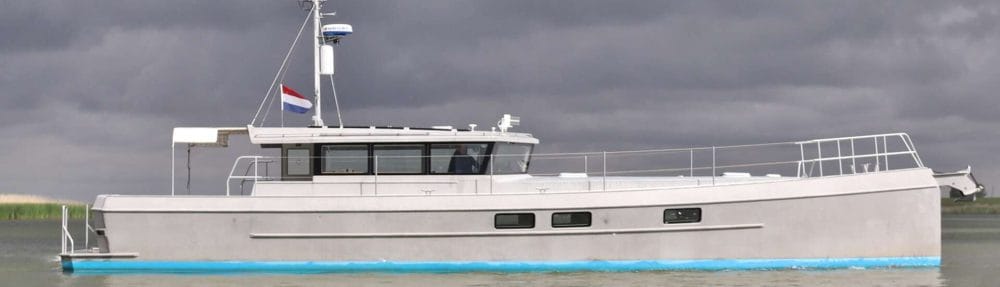
The metal born for the sea
When Dennis Harjamaa set out to design the LRC explorer yachts, one question stood at the very heart of every decision: what material would best serve an owner who intends to go anywhere, in any conditions, and stay out there for years?
The answer was aluminium — and it wasn’t a close call.
Marine-grade aluminium alloy (typically 5083 or 5086 series) is not the thin sheet metal of household objects. It is an engineered structural material, purpose-built for marine environments, combining a remarkable set of properties that no other hull material can match when the destination is the horizon itself.
⚖️ Weight: The Foundation of Every Advantage
An aluminium hull weighs approximately 30–40% less than an equivalent steel hull. That single fact cascades into nearly every other performance advantage an explorer yacht can have.
Less weight means:
- Lower fuel consumption at every speed — critical on passages of thousands of miles
- The ability to carry more provisions, water, fuel, and equipment without paying a speed or efficiency penalty
- A lower centre of gravity when weight is placed low in the hull, improving stability and seakeeping
- Greater range under power for a given tank size
- Compatibility with future hybrid or diesel-electric propulsion systems that reward efficiency
The LRC58 hull, built entirely in aluminium, achieves a Low Displacement-to-Length Ratio (LDLR) — the defining characteristic of an efficient passagemaker. The sleek hull form, combined with aluminium’s low weight, makes effortless cruising speeds and genuinely low fuel consumption possible in a way that simply cannot be replicated in steel at the same displacement. 5
💪 Strength & safety: built to absorb, not shatter
Perhaps the most critical distinction between aluminium and fiberglass (GRP) is what happens when the hull meets something it shouldn’t.
A fiberglass hull fractures on impact. A collision with a submerged container, a rock, floating debris, or ice can create a crack that propagates through the laminate — a potentially catastrophic structural failure requiring immediate attention. 1
An aluminium hull deforms. It absorbs impact energy by bending and denting rather than fracturing. Marine aluminium offers roughly 10 times the shear strength of fiberglass — meaning the hull can take a serious blow and still keep water out. 1 You arrive with a dent you can tell stories about. You do not sink.
For the LRC explorer yachts, hull scantlings (the structural framing and skin thickness) are specified generously — and can be upgraded further for owners venturing into high latitudes. On the most demanding builds in this family, the stem and forefoot plating can be increased to three or more times standard specification, creating a formidable barrier against ice, debris, and ocean floors. 2 The LRC58 is self-righting from a knockdown — a safety capability built into the hull geometry and weight distribution. 7
🛡️ Corrosion: a misunderstood advantage
Aluminium does not rust. This is not a minor detail — it is a structural guarantee.
When aluminium is exposed to oxygen, it forms a thin, stable aluminium oxide layer on its surface. Unlike iron oxide (rust), which continues to eat through steel, aluminium oxide is self-limiting: it seals the surface and prevents further oxidation. The metal effectively protects itself. 3
Steel, by contrast, requires constant vigilance. It must be protected with coatings, monitored for rust, treated and repainted — a cycle that never ends. Neglect it for a season and you may be dealing with structural compromise. The ongoing corrosion management required by a steel hull is one of the defining costs and demands of steel boat ownership. 3
A word on galvanic corrosion: Aluminium can be vulnerable where it contacts dissimilar metals (stainless fittings, bronze through-hulls, copper-based antifouling paints). This is real — and it must be managed properly. On the LRC yachts, electrical systems and metal fittings are designed with galvanic isolation in mind. Sacrificial zinc anodes are inspected and replaced regularly, and the choice of compatible underwater hardware is not an afterthought. Managed correctly, an aluminium hull can last for many decades without structural corrosion. 4
🔧 Maintenance: less time in the boatyard, more time underway
One of the most compelling arguments for aluminium on a long-range explorer yacht is how little it demands of you once you are away from the facilities of home.
- No gelcoat to wax, polish, compound, or repair every season
- No rust to treat, no corroded sections to cut out and patch
- No osmosis — the waterborne blistering that plagues fiberglass hulls and can require expensive hull stripping and epoxy treatment
- The primary maintenance tasks are hull washing, periodic inspection and replacement of sacrificial anodes, and checks on weld integrity
The LRC yachts were designed with the philosophy that simplicity enables freedom. The designer chose aluminium in part precisely because it can be left unpainted — reducing maintenance to a minimum and giving the boat a purposeful, functional aesthetic that fits naturally into working harbours around the world. 6
Compare this to fiberglass, which requires waxing every two to four months, periodic compounding for UV oxidation, and prompt gelcoat chip repair to prevent water intrusion into the laminate beneath. 1 Or steel, which demands an ongoing commitment to blasting, coating, and monitoring for the rust that will always eventually return.
🔩 Repairability: welded, not glued
When something does go wrong with an aluminium hull — a grounding, a collision, storm damage — the repair is fundamentally logical: weld it.
Aluminium is welded using TIG (Tungsten Inert Gas) welding, a process that creates clean, strong, corrosion-resistant joints using the same material as the hull itself. There are no resins to mix, no cure times to wait for, no concern about whether a structural repair has achieved its designed strength. The weld is as strong as — or stronger than — the surrounding material.
The LRC yachts are built by specialist aluminium yards with deep expertise in marine alloy construction. The same type of yards have built Whitbread Around The World Race yachts and other serious offshore vessels. 2 The knowledge and skills exist globally — and in an emergency, a competent welder with TIG equipment can effect a structural repair almost anywhere in the world.
It is worth noting that because aluminium hulls absorb impact rather than fracturing, the need for structural repairs arises far less frequently than with fiberglass. Dents that would be cosmetic failures in GRP are often simply left as badges of experience on an expedition yacht. When repairs are needed, they are permanent.
♻️ Longevity & environmental responsibility
Aluminium lasts. An aluminium hull built with care and maintained thoughtfully does not have a finite life imposed by material degradation. It does not suffer osmotic blistering. It does not develop hidden delamination. It does not rust from the inside out. The limiting factor for an aluminium yacht is far more likely to be the equipment inside it than the hull itself.
Aluminium is also completely recyclable. Recycling aluminium requires only 5% of the energy needed to produce new aluminium from ore. 1 At end of life, an aluminium hull can be melted down and reformed with minimal energy loss.
Fiberglass, by contrast, is non-biodegradable and notoriously difficult to recycle. Decommissioned GRP boats typically end up in landfill — a growing problem for the marine industry worldwide. 1 For owners who care about the footprint of their adventures, aluminium carries a substantially smaller lifecycle environmental impact.
Material comparison at a glance
| Property | Aluminium | Steel | Fiberglass (GRP) |
|---|---|---|---|
| Weight | ✅ Lightest metal option | ❌ ~30–40% heavier | ✅ Light (but varies) |
| Impact resistance | ✅ Deforms, doesn’t fracture | ✅ Excellent | ⚠️ Cracks under impact |
| Corrosion | ✅ Self-protective oxide layer | ❌ Rusts — constant management required | ✅ Immune to corrosion |
| Osmosis risk | ✅ None | ✅ None | ⚠️ Yes — blistering possible |
| Routine maintenance | ✅ Low — anodes, cleaning | ❌ High — coatings, rust prevention | ⚠️ Medium — gelcoat waxing, UV care |
| Repairability | ✅ TIG welding — permanent structural repair | ✅ Welding — widely available | ⚠️ GRP layup — accessible but structural repairs are complex |
| Fuel efficiency | ✅ Excellent (low weight) | ❌ Higher consumption | ✅ Good (lighter forms) |
| Longevity | ✅ Decades+ with proper management | ✅ Decades with maintenance | ✅ 30+ years, but osmosis risk |
| Extreme cruising grounds (ice, remote) | ✅ The preferred choice | ✅ Capable | ⚠️ Limited — not ideal for ice |
| Recyclability | ✅ Fully recyclable at 5% of energy cost | ✅ Recyclable | ❌ Difficult — typically landfill |
| Noise & thermal insulation | ⚠️ Requires insulation treatment | ⚠️ Requires insulation treatment | ✅ Natural insulating properties |
Made for explorer yachts
The LRC is not a coastal cruiser. It is not designed for Mediterranean summers and marina berths. It is designed for the places most boats never go — remote anchorages, high latitudes, long ocean crossings, rivers and passages that test both vessel and crew.
For that mission, aluminium is not merely a good choice. It is the logical conclusion of every design requirement:
- Go anywhere — the hull can take what the ocean throws at it
- Stay out — low maintenance, long service intervals, high reliability
- Be self-sufficient — a repairable hull that doesn’t depend on specialized facilities
- Travel efficiently — light weight and efficient hull form minimise fuel consumption on passages of weeks
- Last a lifetime — a hull that is still structurally sound when the engine, electronics, and systems have been replaced twice over
That is why every LRC explorer yacht is built in aluminium. Not as a compromise, and not as a tradition — but as the considered answer to the question of what an offshore passagemaker truly needs to be.