…This Voyage — and the Person Behind It
A third circumnavigation. This time, on my own terms.
I made my first 2 circumnavigation in 1983-84 at age 21. Not as a passenger — as an apprentice engineer in the merchant marine, learning the sea from the inside out: engine room rounds at four in the morning, stokehold watches, the particular education that comes from crossing every ocean on the planet in a working ship.
That experience gives you things no course can teach. A deep, physical respect for the sea and what it can do. An understanding of machinery not as a diagram but as something alive — something that tells you when it is unhappy, something that rewards careful attention and punishes complacency. And the knowledge that what keeps people safe out there is not optimism. It is preparation, maintenance, and systems that work.
Three grown children, now living full lives of their own. A career that has taken me further than I once imagined. And a question, sitting quietly in the background for longer than I care to admit.
When do I make the third one?
The answer turned out to be: now. But on different terms entirely. Not in a ship with a crew of thirty, running to someone else’s schedule between ports I had no say in choosing. This time: a vessel I commissioned and built myself. A route I designed. An ocean approached as a free person rather than an employee.
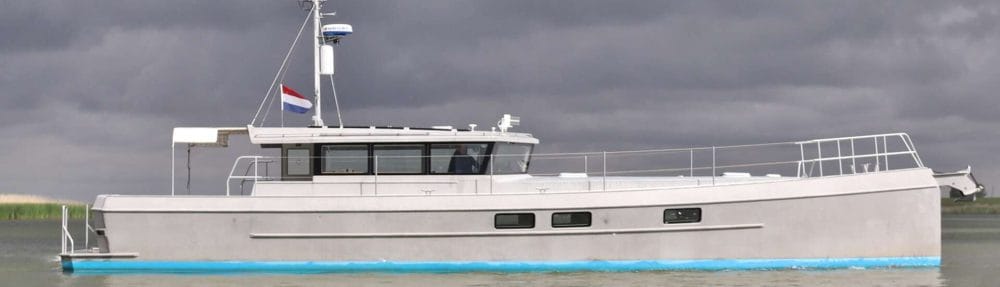
That is Sustainable Expeditions. That is Hugarró.
Why a Motor Yacht. Why the LRC.
People who know my background sometimes assume I will make the case for sail. I understand that impulse — the romance of it is real, and I have profound respect for serious offshore sailors.
But I have spent enough years at sea to know what actually keeps people safe, and what actually gets vessels into trouble.
A career as a marine engineer gives you a specific relationship with mechanical systems. A well-designed diesel installation, a properly laid electrical system, a sensibly engineered fuel system — these are predictable. They tell you when something is wrong. They respond to maintenance. They do not depend on the wind being in the right place, and they do not have critical components swinging at the top of a 20-metre mast.
A sailing rig is a collection of high-load components exposed to UV, salt, fatigue, and shock loading — and the failure modes, when they come, have a habit of arriving at exactly the wrong moment. I have seen enough of that to have formed a clear view.
When I found the ArtNautica LRC range, I recognised something immediately: here was a designer who had done the same calculation and arrived at the same place. The LRC is not a conventional trawler-style motor yacht — heavy, beamy, thirsty. It is a purpose-engineered long-range passagemaker, designed from the keel up for efficiency and ocean capability. 5,000 nautical miles of range. 0.80 litres per nautical mile at cruising speed. A self-righting hull. 0.95 metres of draft. And a design philosophy that asks exactly the right question: what does a serious long-distance voyager actually need?
I ran the numbers on total cost of ownership — rig replacement, sails, antifouling, haul-outs, rigger fees on a comparable sailing yacht — against the LRC’s fuel costs and maintenance schedule. The LRC is not a more expensive way to cross oceans. In many real-world cases it is cheaper. And it gets you there regardless of the wind angle.
A smartly designed motor yacht, properly maintained by someone who understands it, is the safest way I know to travel the world’s seas. The LRC range is the proof of that argument in aluminium.
The technical side — and why it matters
I am currently prepareing for my RYA Yachtmaster Offshore and Ocean certification — the internationally recognised qualification for offshore passage-making under commercial endorsement. I take it seriously. The sea demands that you can prove what you know, not just know it.
But the certificate is the formal layer on top of something deeper. A career in the merchant marine teaches you to think through systems problems calmly and methodically — a discipline that does not leave you when the conditions outside are doing their best to prevent calm and methodical thinking. I know what a healthy engine sounds like. I know how to trace an electrical fault at sea. I know how to manage a fuel problem, a watermaker failure, an autopilot issue — not from a manual, but from experience.
That background is, I believe, the most important safety asset aboard Hugarró. Not the equipment — though the equipment is carefully chosen. Not the hull — though the hull is exceptional. The knowledge to operate and maintain both, anywhere on earth, in whatever the ocean decides to offer.
What sustainable expeditions actually is
This is a commercial project with a clear structure. Hugarró is operated as a demonstrator vessel for the ArtNautica LRC range — funded through short paid passages for prospective buyers who want to experience the boat in real ocean conditions before they commit to a build of their own. Through equipment sponsorship from manufacturers who want honest, long-range evaluation of their products at sea. And through a modest referral arrangement with ArtNautica when a guest goes on to commission their own LRC.
I mention this not as a disclaimer but as context. This is a real business with a real service at its heart: giving serious passagemaker prospects access to a working vessel, on a real ocean passage, so they can make the most significant purchasing decision of their seafaring lives with complete information.
What it is not is a charter holiday. There is no itinerary designed around comfort and cocktail hours. The skipper is also the engineer, navigator, content creator, and the person who will be on deck if the weather changes at 0200. Guests who come aboard are participants, not passengers — they helm the boat, stand watches, ask questions, and get honest answers.
If you have ever seriously considered building a passagemaker and crossing an ocean of your own, that is exactly who this project is for.
A final note
I have crossed a great deal of water in my life, in a great many vessels, in conditions that ranged from glorious to genuinely alarming. That history taught me to trust preparation over optimism, and systems over improvisation.
What I have not yet done is cross an ocean entirely on my own account — in a vessel I chose, in a direction I decided, stopping where I want to stop and staying as long as the place deserves.
Hugarró is that vessel. This voyage is that crossing.
I am glad you found your way here.
Thorwald Westmaas, Skipper & Owner, Hugarró
[Button] → The Build — equipment choices and build diary
[Button] → The Route — where we are going and why
[Button] → Book a Demo Trip