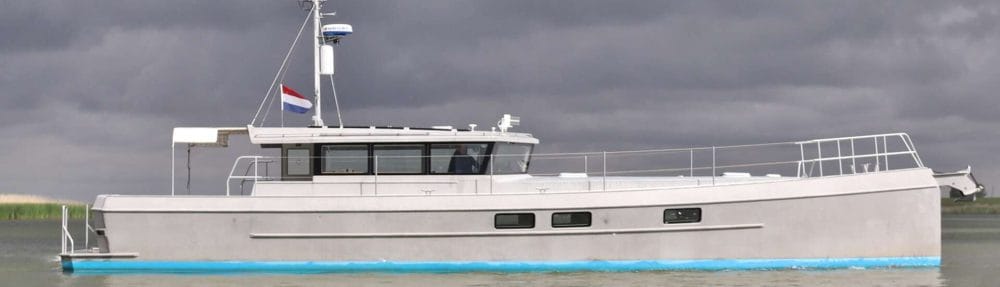
The Honest Comparison: LRC vs. Sailing Yacht
Sailors make the best passagemakers. But the best passagemaker is not always a sailing boat.
We respect sail. We just did the numbers.
There is something profound about sailing. The silence. The connection to wind and sea. The satisfaction of harnessing nature to move across an ocean without burning a drop of fuel.
But here is what nobody talks about at the sailing club bar.
The Real Cost of a Sailing Rig
A cruising sailing yacht of comparable size (55–60 feet) requires:
| Item | Cost / Lifecycle |
|---|---|
| Mast, rigging, standing rigging | €40,000–80,000 new; replace every 10–15 years |
| Sails (main, headsail, spinnaker, storm) | €25,000–50,000; replace every 5–8 years |
| Winches, furlers, travellers, blocks | €15,000–30,000 |
| Rigger maintenance (annual) | €3,000–8,000 |
| Haul-out and antifouling | €4,000–10,000/year |
| 10-year rig cost estimate | €150,000–300,000 |
The LRC58’s 10-year fuel cost at 10,000 nm/year: approximately €9,000/year — or €90,000 over a decade. Less than the rig alone on a comparable sailing boat.
And that is before you consider the operational reality.
What Sailing Actually Demands on Ocean Passages
- Reefing at 0300 in building winds while the autopilot struggles
- Extended passages to windward — uncomfortable, slow, punishing on boat and crew
- Seasickness — the rolling motion of a sailing yacht under sail is significantly greater than a stabilised passagemaker in the same conditions
- Weather routing constraints — you need the right angle to the wind, not just a destination
- Crew requirements — single-handed ocean sailing is genuinely demanding in a way that the pilothouse of an LRC is not
- Mast inspection — every time you come into port after a hard passage, you worry about what you didn’t see up the rig
What the LRC Gives You Instead
✅ Point anywhere, depart anytime. No weather window needed for tacking angle — if the sea state is manageable, you go.
✅ Stabilisers. Optional active fin, gyroscopic, or Magnus rotor stabilisers reduce rolling to a fraction of a sailing yacht’s motion. Sleep at sea, cook at sea, work at sea — in comfort. 1
✅ The pilothouse. An enclosed, heated, all-weather helm station with full instrumentation. The ocean in front of you, coffee in hand, entirely dry. The LRC’s wheelhouse and cockpit are on one level for effortless indoor-outdoor flow. 1
✅ Shallow draft. At 0.95m, the LRC58 goes places a 60-foot sailing yacht simply cannot: French canals, shallow-water anchorages in the Pacific, remote rivers, tidal harbours. 1
✅ Low air draft. No mast means no height restriction. Bridges, covered marina berths, canal locks — all open to you.
✅ 5,000 nm range without refuelling. That is the Atlantic with fuel to spare. Or the entire Pacific island chain. 1
✅ Future-proof propulsion. The hybrid option and 3kWh solar array (expandable) mean the LRC is already compatible with the energy transition. At slow speeds, running on electric drive with solar topping up the batteries, diesel consumption approaches zero. 4
The Bottom Line
A sailing yacht crosses oceans beautifully — when the wind cooperates. An LRC crosses oceans reliably, at lower total cost of ownership, in greater comfort, and with fewer demands on the skipper and crew.
If you have spent years sailing and love it — you will still love the LRC. You will just wonder why you spent so much time at 30 degrees of heel.