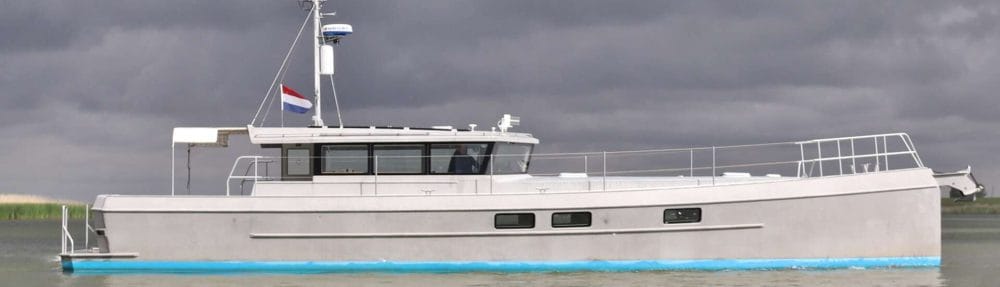
and why the Sleipner Vector Fins excel
Why we want stabilizers on our LRC58
The Artnautica LRC58 is engineered for long offshore passages — often thousands of miles, with minimal crew, in open-ocean swell. This creates a compelling case for active stabilization:
- Crew fatigue & safety: Constant rolling on long passages is physically exhausting, degrades decision-making, and increases fall/injury risk. Stabilization directly improves crew welfare.
- Sleep quality: On short-handed passages, off-watch crew must sleep. Excessive roll makes restful sleep nearly impossible.
- Comfort at anchor: Remote anchorages often have residual swell. Without stabilization, nights at anchor in exposed spots can be miserable.
- Structural stress: Repetitive rolling accelerates wear on interior fittings, crockery, equipment, and the crew themselves.
- Speed & efficiency: Active fins generate hydrodynamic lift, which can slightly improve performance and fuel economy — relevant on 5,000 nm range passages.
Why Sleipner Vector Fins are the right choice
The Core Technology
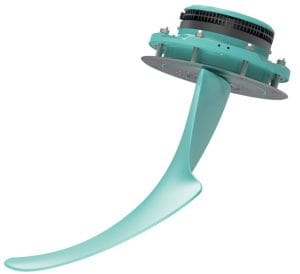
The Vector fins use a radically curved fin shape — unlike traditional flat fins — generating more vertical stabilising force while reducing lateral drag. The system is fully electric, using a brushless torque motor and an integrated Harmonic Drive strain-wave gear, eliminating hydraulics entirely.
A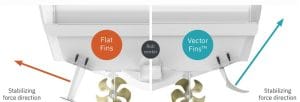 key differentiator is the self-learning predictive algorithm — rather than simply reacting to roll, the system analyses wave periods and heights, and after just 3–4 waves begins anticipating the wave pattern and pre-emptively countering roll before it happens.
Key Advantages
| Feature | Detail |
|---|---|
| Exceptional roll reduction | Up to 86% reduction in roll angle and 98% reduction in roll energy in typical anchoring conditions (1–2 ft beam swell), confirmed in real-world tests |
| Effective at anchor | Unlike most fin stabilizers, the curved design allows the fins to paddle fore/aft at zero speed, reducing roll by up to 90% while at anchor — a significant edge over flat fins |
| Energy efficiency | 145% more energy-efficient than previous designs; at anchor, roughly doubles stabilising force per kW compared to flat fins, enabling all-night use without significant battery drain |
| Predictive algorithm | Self-learning system that anticipates wave patterns after 3–4 waves, acting pre-emptively rather than just reactively — delivering smoother, faster response |
| Virtually silent | A specialised gasket isolates the motor and gears from the hull, reducing structure-borne noise by 92% — in testing, reviewers “struggled to discern any noise at all” even close to the mounting point |
| No hydraulics | Fully electric system — no hydraulic fluid, no pumps, no associated maintenance or leak risk. Simpler and more reliable for long-range offshore cruising |
| User-adjustable intensity | Stabilisation level is adjustable from 0–100%, so crew can dial in how much motion they want — or retain a feel of being at sea if preferred |
| Scalable sizing | Available in six sizes (0.55–2.2 m²) covering vessels from 45 ft to 150 ft, making the right fin size readily available for the LRC58 |
| DAME Design Award winner | Recognised with the prestigious DAME Design Award in 2013, validating its engineering innovation |
Bottom Line
 For an LRC58 owner undertaking extended offshore passages, the Sleipner Vector Fins address the single biggest quality-of-life issue on long voyages — persistent roll — both underway and at anchor, without the complexity of hydraulics or the weight/cost of a gyroscopic stabiliser. The combination of predictive algorithm, near-silent operation, and outstanding energy efficiency makes them an ideal fit for a vessel designed around self-sufficient, long-range passage-making.