A navigation & safety overview
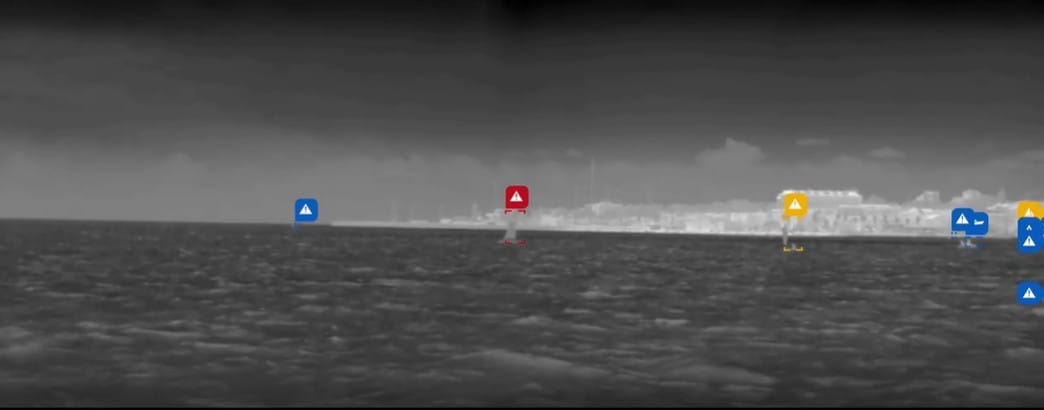
The SEA.AI Watchkeeper is a mast- or skyline-mounted AI vision system combining 4K low-light RGB cameras with thermal imaging (on most models). All data processing runs locally on an onboard edge-computing module — no cloud dependency. It integrates with your MFD or a wireless device, overlaying a live video feed with augmented-reality tags that classify detected objects and colour-code them by threat level (blue/orange/red). It also places targets on a simplified chart and triggers escalating auditory and voice alarms.
Why It’s a Valuable Addition
The core value proposition is that it detects hazards that radar and AIS routinely miss.
| Capability | Radar / AIS | Watchkeeper |
|---|---|---|
| Large ships | ✅ | ✅ |
| Unlit small craft / dinghies | ❌ | ✅ |
| Floating debris / containers | ❌ | ✅ |
| People overboard | ❌ | ✅ |
| Marine mammals (whales) | ❌ | ✅ |
| Growlers / drift ice | ❌ (low freeboard) | ✅ (v4.1+) |
| Night / low-light operation | Partial | ✅ (thermal models) |
| 24/7 fatigue-free monitoring | ❌ | ✅ |
The AI is trained on a database of more than 20 million annotated maritime images, using a convolutional neural network to extract patterns and classify unseen objects. Object detection works through feature extraction (contours, shapes, movement), classification against predefined categories, and multi-frame tracking to record position and speed.
Can It Replace an Officer of the Watch?
No — and it is explicitly not designed to. Christian Rankl, Sea.AI’s CTO, is clear: “Watchkeeper is an alarm-only system, so it’s a navigation-assistance system.” It cannot autonomously adjust the autopilot; a human operator must make all course decisions.
What it does do is provide capabilities a lone watchkeeper cannot sustain:
- Zero fatigue — it scans continuously, even at night when contrast drops and unlit objects blend into darkness.
- Reaction time buffer — at 30 knots, the top motor models provide up to 2 minutes 42 seconds of warning time from detection to potential impact.
- Wide-field simultaneous awareness — it monitors a wide arc ahead without the human tendency to fixate on a single sector.
Think of it as a tireless, always-on second pair of eyes that complements — not replaces — the OOW.
Icebergs, growlers & whales
🧊 Icebergs
The thermal camera detects icebergs through temperature differential — even though ice is cold, the contrast between the iceberg and surrounding sea surface is sufficient for detection, including at night. This is particularly valuable for medium-sized icebergs that present a low freeboard and are therefore unreliable radar targets. As Team Malizia’s navigator noted after Antarctic missions: “I was also quite surprised by the thermal version. Even though you would think an iceberg is cold, with the temperature difference between the ocean and the iceberg, you can really spot anything, even at night.
Sea.AI has been collecting real-world thermal and visual imagery from Antarctic voyages with Team Malizia to continuously refine these detection models.
🧊 Growlers
Growlers (partially submerged ice fragments, often transparent, truck-sized, and less than 1 metre above the waterline) are among the hardest maritime hazards to detect — nearly invisible to radar in rough seas. The v4.1 software update (June 2026) specifically retrains the thermal AI models to address this, with growlers and drift ice named as priority targets and described as showing “a clear improvement in detection confidence and range.” This remains an active area of development — Watchkeeper is better at growlers than any previous tool, but is not infallible.
🐋 Whales
Watchkeeper detects and tracks surfacing whales, issuing bearing and audible alerts to avoid collision. 3 Sea.AI’s whale detection capability is also being deployed scientifically — the company is collaborating with the Irish Whale and Dolphin Group (IWDG) and the University of La Laguna under the EU’s Atlantic Whale Deal project to monitor surfacing whales and prevent ship strikes. Whale detection was also explicitly improved in the v4.1 thermal AI retraining.
Summary
Watchkeeper is best understood as a force multiplier for safety, not an autonomous navigator. It brings 24/7, fatigue-proof, thermal-enhanced vigilance to vessels of any size — detecting threats that radar, AIS, and tired human eyes routinely miss. For icebergs and whales, it delivers genuine capability; for growlers, it is now significantly improved but remains an evolving technology. The human watchkeeper retains all decision-making authority — Watchkeeper simply ensures they are informed in time to act.