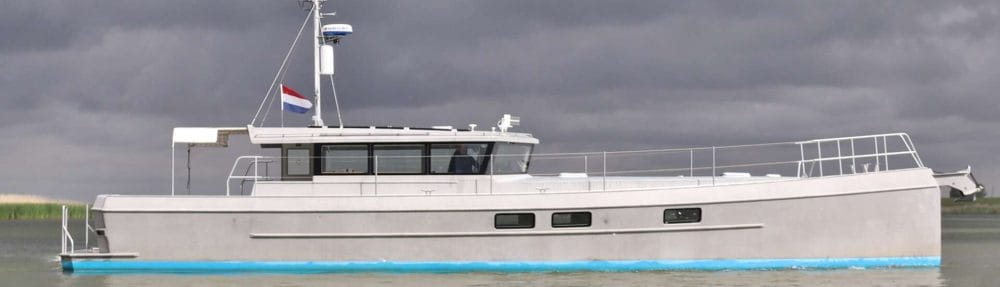
The ArtNautica LRC series was born from one designer’s refusal to accept compromise. The result is the most efficient, capable ocean-going passagemaker ever conceived.
A design born from obsession
In the mid-2000s, New Zealand naval architect Dennis Harjamaa sat down to design his ideal vessel. Not a yacht for the boat show circuit. Not a floating apartment. A serious, go-anywhere machine that he could live aboard, maintain himself, and take anywhere on earth — economically, safely, and without fuss.
His starting point was the sailor’s toolkit. He sketched masts, sails, rigging. And then he did the maths.
> “I was initially going to build a sailing yacht, feeling that sailing would be more economical. It soon became apparent, though, that for the cost of the mast, sails, rigging, and related maintenance costs, I’d be able to buy enough fuel to go a very long way indeed.”
> — Dennis Harjamaa, Designer, ArtNautica
That insight became the LRC — the Long Range Cruiser. A passagemaker that takes the efficiency argument away from sailing and hands it back to power.
The four principles
Everything about the LRC design flows from four founding priorities:
1. Rugged simplicity
No mast. No rigging. No sails to reef at 3am in a gale. The engine that drives an LRC58 is the same size you’d find as an auxiliary in a sailing yacht of the same length — except here, it is the only engine, driving a large, slow-turning propeller with extraordinary efficiency. There is less to go wrong, and everything that can go wrong is accessible, fixable, and designed to be maintained by the owner.
2. Efficiency
The LRC hull form is radically different from conventional trawler-style motor yachts. Most trawlers in this size category are heavy, beamy, and tall — maximising interior volume at the expense of speed and fuel burn. The LRC does the opposite. Its Low Displacement to Length Ratio (LDLR) gives it a sleek, sea-kindly hull with maximum waterline length and minimal wetted surface. The result: 0.80 litres of diesel per nautical mile at cruising speed. 1 That is not a theoretical number. It is the real-world consumption of boats in the water, crossing oceans, right now.
3. Safety
The LRC58 is self-righting — if knocked flat by a breaking wave, it returns upright. Watertight bulkheads fore, midships and aft provide redundant damage control. The hull is marine-grade aluminium, built to withstand the kind of treatment that fibreglass cannot. Shallow 0.95m draft keeps you off reefs and out of trouble. 1
4. Affordability
This is not a superyacht with a superyacht’s operating costs. The engine is a Beta Marine — a simple, proven, commercially-operated British diesel with excellent parts availability worldwide. Fuel costs at cruising speed are a fraction of comparable motor yachts. The unpainted aluminium hull requires no antifouling, no polishing, and blends into workboat harbours everywhere from Norway to Vanuatu. 2
Built for the real world
> “The comfort of sitting in a stout pilothouse when it’s windy and rainy outside is priceless. A shallow draft allows entry into the most exciting cruising grounds, including European canals. With low air draft, bridges are no obstacle.”
> — Dennis Harjamaa 2
With the LRC, you point at your destination and you go. No weather windows for tacking angles. No waiting for the right breeze. The pilothouse keeps you warm and dry at all times. And when you arrive, that 0.95m draft opens up anchorages, canals, and inlets that deeper, heavier vessels cannot reach.
This is what freedom of movement actually looks like.